
The UK Board Class 10 result 2026 is more than just a marksheet. It marks the beginning of an important decision, choosing your stream for Class 11. For many students, this stage can feel confusing and stressful, especially with opinions coming from all sides, including family, teachers, and friends. But stream selection is not about following trends. It is about choosing what genuinely fits your interests and strengths.The three main streams available after Class 10 are Science, Commerce, and Arts (Humanities). Each opens different career paths, and none is “better” than the other. What matters is how well your choice aligns with your abilities and long-term goals.
Science: For Logic and Technical Careers
Science is often seen as the most demanding stream. It includes subjects like Physics, Chemistry, Mathematics, and Biology. If you enjoy logical thinking, problem-solving, and have an interest in fields like engineering, medicine, research, or technology, Science could be a good fit. However, it requires strong focus and consistency, as the syllabus can be intensive.
Commerce: For Business, Finance, MBA
Commerce focuses on subjects like Accountancy, Business Studies, and Economics. It is ideal for students interested in finance, business, entrepreneurship, or careers such as Chartered Accountancy (CA), Company Secretary (CS), or management roles. If you are comfortable with numbers, analysis, and understanding how businesses function, Commerce can offer solid career options.
Arts/Humanities: For Social Sciences
Arts or Humanities is often underestimated, but it offers diverse and flexible career paths. Subjects like Political Science, History, Psychology, Sociology, and Geography fall under this stream. It suits students interested in law, media, civil services, academics, writing, or social research. With changing career trends, Humanities has become a strong and relevant choice.
.
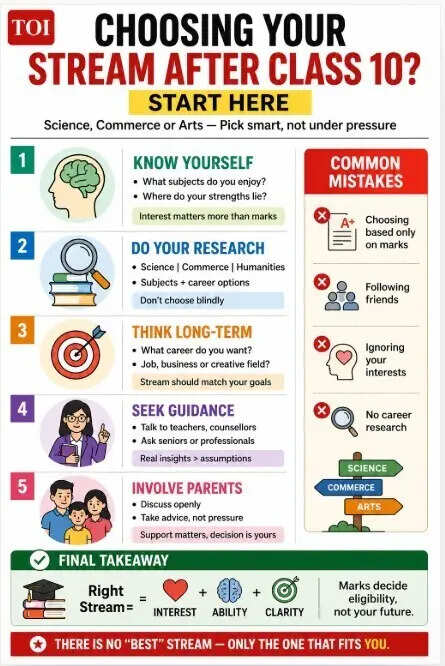
One common mistake students make is choosing a stream purely based on marks. While marks can indicate where you performed well, they should not be the only deciding factor. Career experts often point out that marks decide eligibility, not direction. Interest, aptitude, and comfort with subjects matter much more in the long run.Parents also play a key role during this phase. Instead of pushing for a “safe” or popular option, it helps to have open conversations and understand what the student actually wants. A supportive approach leads to better decisions and less pressure.If you are still unsure, consider speaking to a career counsellor or taking an aptitude test. These tools can help you understand your strengths and possible career paths more clearly.In the end, there is no perfect stream, only the one that is right for you. Take your time, think carefully, and choose a path you can commit to, not just one that looks good on paper.