

India’s world of work is changing. Businesses today operate in an environment marked by rapid technological shifts, evolving geopolitical dynamics, seasonal demand cycles, project‑based work and intense global competition. Geopolitical realignments, supply‑chain reconfiguration and cross‑border regulatory developments are influencing how organisations plan operations and deploy talent. At the same time, employees are increasingly open to diverse career paths that may include short‑term assignments, project roles or specialised engagements.Against this backdrop, fixed term employment (FTE) is steadily emerging as a mainstream form of hiring. Far from being an exception, it is now formally recognised and regulated under India’s new labour codes, particularly the Industrial Relations Code, 2020 and the Code on Social Security, 2020. Rather than creating a new concept, the labour codes acknowledge a reality that already exists in many sectors — and bring it within a clearer, more transparent legal framework.
What is fixed term employment?
In simple terms, fixed term employment means hiring an employee directly on the employer’s payroll for a clearly defined period, backed by a written contract. The contract specifies the start date and the end date, and the employment comes to an end automatically once the term expires.For example, a company may hire a software tester for a 12-month product implementation project, or a manufacturing unit may recruit additional technicians for a six-month peak production cycle. Once the period ends, the contract concludes by design.The labour codes formally define and recognise such arrangements, removing ambiguity around their legality.
Why fixed term employment matters in today’s economy?
India’s economy increasingly relies on time-bound projects and specialised skills. Infrastructure projects, digital transformation initiatives, expansion into new markets, compliance-led programmes and seasonal business spikes all require manpower for defined durations.Earlier, organisations often relied on contractor arrangements to meet these needs. The labour codes take a different approach – they encourage direct employment, even if the engagement is for a limited period.This shift supports a more formal labour market while allowing businesses to remain agile.
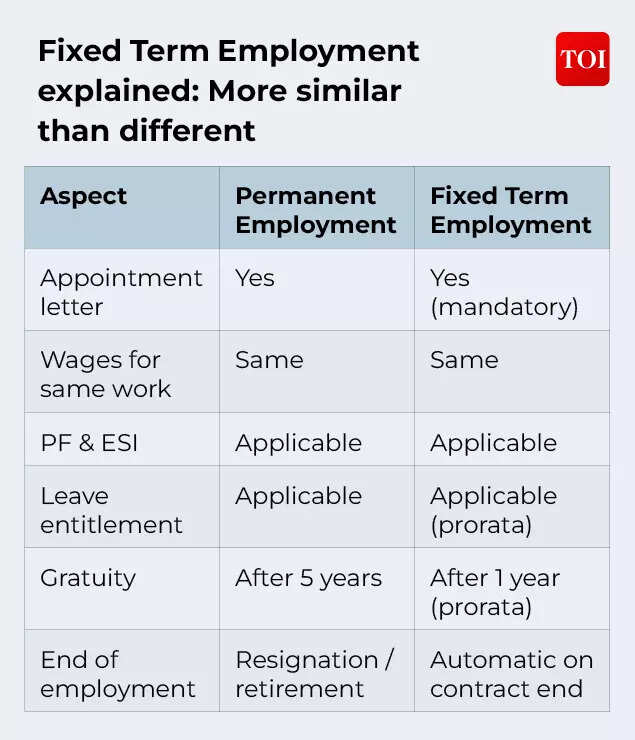
Equal treatment under the labour codes
One of the most important features of fixed term employment under the labour codes is parity of treatment. A fixed term employee is entitled to the same wages, working hours, allowances and statutory benefits as a permanent employee performing similar work. The only difference lies in the duration of the employment, not in the quality of protection.This means that a fixed term employee cannot be paid less simply because the contract is time-bound. Provident fund, ESI (where applicable), leave entitlements and other statutory benefits apply in the same manner, calculated proportionately. Consider a technology services company undertaking a time‑bound enterprise system migration for a large client, such as moving legacy applications to a cloud‑based platform. To support this programme, the company hires experienced project managers and solution leads on a nine‑month fixed‑term basis. These professionals are issued formal appointment letters clearly setting out the fixed duration of employment. During the contract period, they are paid wages and benefits comparable to permanent employees performing similar roles and are covered under applicable social security provisions, including provident fund. Once the migration project is completed and the systems are stabilised, the employment comes to an end automatically in line with the contract terms. This arrangement allows the organisation to access specialised capabilities for a defined period while providing employees with clarity, parity and statutory protection.
Gratuity and social security: A notable change
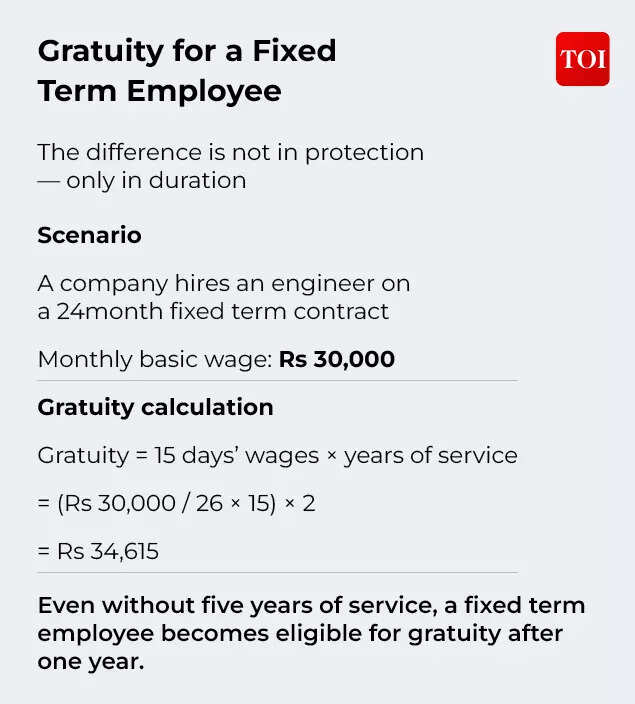
A significant reform under the Code on Social Security, 2020 relates to gratuity eligibility for fixed term employees.Traditionally, gratuity required five years of continuous service. Under the labour codes, fixed term employees become eligible for gratuity on a pro-rata basis after completing one year of service.This is particularly relevant for project-based roles that may last one to three years and were earlier outside the gratuity framework.For instance, an engineer hired on a two-year fixed term contract for a renewable energy project would now be eligible for gratuity at the end of the contract, proportionate to the period worked.
Predictability for employers, transparency for employees
Fixed term employment introduces predictability into workforce planning. Employers know the duration of engagement upfront, while employees have clarity on tenure, compensation and benefits from day one.Importantly, the end of a fixed term contract does not amount to retrenchment under the Industrial Relations Code, as the employment ends by the “efflux of time” specified in the contract.This legal clarity reduces disputes and allows organisations to plan staffing needs more efficiently, especially in sectors affected by demand cycles.
Where fixed term employment is commonly used
Fixed‑term employment is prevalent across a wide range of sectors in India, including information technology and digital services, manufacturing and engineering, e‑commerce and logistics, infrastructure and construction, hospitality and tourism, as well as research, consulting and project‑based roles. These arrangements are commonly used to meet time‑bound business requirements, manage demand variability, or access specialised skills for defined periods. Importantly, the labour codes do not restrict fixed‑term employment to specific industries, allowing organisations across the economy to use this model as a flexible and compliant workforce option.Fixed term employment is not contract labour – It is important to distinguish fixed term employment from contract labour.A fixed term employee is directly employed by the organisation and works under its supervision and control. This is different from contract labour, where workers are engaged through a contractor.By encouraging fixed term hiring on the principal employer’s rolls, the labour codes promote greater accountability and reduce dependence on multi-layered contracting structures.
What it means for employees and employers
For employees, fixed‑term employment provides access to formal employment arrangements with full statutory benefits, along with opportunities to work on high‑impact assignments and well‑defined projects. It enables greater mobility across roles, organisations and industries, while offering clarity through transparent contractual terms and a clearly defined tenure. Many professionals today increasingly view fixed‑term roles as a practical way to build specialised skills, gain exposure to different sectors, or contribute to large and meaningful projects, without necessarily committing to long‑term employment.For employers, it enables workforce flexibility that can be aligned closely with business cycles, project timelines and evolving operational needs. It provides a compliance‑backed framework for short‑term hiring, allowing organisations to plan manpower requirements with greater certainty and discipline, rather than relying on informal or ad‑hoc arrangements. Fixed‑term roles also support better cost planning while reducing legal ambiguity around tenure‑based positions, as the duration and terms of employment are contractually defined from the outset. As organisations revisit compensation structures and workforce strategies in the context of the labour codes, fixed‑term employment is increasingly being viewed as a legitimate and deliberate workforce design choice, rather than an exception to standard employment models.
A gradual but steady shift
The labour codes do not mandate the use of fixed term employment. Instead, they create an enabling framework where such arrangements can be used responsibly and transparently.Over time, as state rules are finalised and organisations align their HR practices, fixed term employment is likely to coexist alongside permanent roles, each serving different business needs.Rather than replacing permanent employment, fixed term roles complement it — particularly in a fast-changing economy where not all work fits a one-size-fits-all model.Fixed term employment reflects a broader shift in India’s labour landscape: from informality to formalisation, from ambiguity to clarity, and from rigid structures to balanced flexibility.By recognising and regulating fixed term employment, the labour codes acknowledge modern work realities while ensuring statutory protections remain intact. As businesses and professionals adapt to this framework, fixed term employment is steadily becoming part of the new normal — structured, transparent and aligned with India’s evolving economy.(Puneet Gupta is Partner, People Advisory Services Tax at EY India)