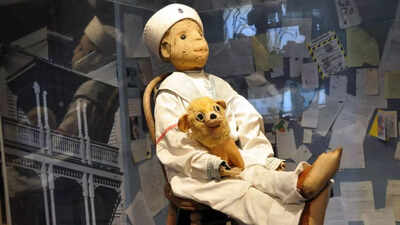
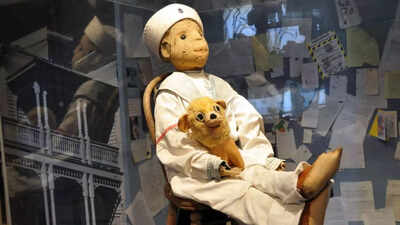
While Annabelle may be a superstar in Hollywood, there is one toy that is creepier than her- that’s Robert the Doll. The straw-filled sailor has been entertaining and frightening people since 1904 and can be found at the Fort East Martello Museum in Key West. Originally purchased by artist Gene Otto, there are allegedly many sightings of Robert moving on his own, changing facial expressions, and even witnesses have claimed to hear disembodied giggling emanating from the doll as they turned their backs. Today, Robert sits in a glass case in the museum and has thousands of apology letters from people who visited him. Legend states that if you take a picture of Robert without first politely asking him, you will experience severe bad luck. People write to Robert from all over the world begging him to forgive them and free them from their curses.
Why Robert out-creeps Annabelle
Though Annabelle from Hollywood is a quiet character who serves as a backdrop to the ‘Warning’ displayed with her, Robert the Doll is described as an interactive psychological being. At 40 inches tall, Robert is a custom-made doll who can reportedly take on different facial expressions as well as impose his own terrifying ‘Rule of Consent.’ While Annabelle is used to create fear through the movies, Robert has been associated with thousands of documented letters where individuals report things like car accidents, getting sick, and experiencing financial difficulties after taking an unauthorized photograph of Robert or disrespecting him in some way; therefore, those who have ‘disrespected’ Robert have been placed under a real-world curse that is much more creepy than anything found in a movie script.
The origin of the 100-year-old Robert the Doll
According to the Key West Art & Historical Society, the journey of Robert the Doll commenced when he was presented as a birthday present to Robert Eugene ‘Gene’ Otto of Key West, Florida, in 1904. Robert is not made like most toys, but he is a one-of-a-kind collector’s item at approximately 40 inches tall that is filled with wood wool, or shavings from different woods, and dressed in a white sailor suit that may have originally belonged to the boy. As Robert became an integral part of the young boy’s life (developing a strong attachment), the little boy gave his doll his name of ‘Robert’ and started using Gene by itself to differentiate between himself and his cherished friend.
Reports from the Otto home
As Gene grew up, the family and staff reported occurrences of a strange nature in the residence. They would hear the doll laugh and experience the expression on the doll’s face changing right in front of them. Visitors would often tell of seeing the doll move about as if it were moving between windows of the second floor of the Otto residence, now known as The Artist House. Whenever Gene was at fault or when household items were broken, Gene would say to his parents, ‘I didn’t do it, Robert did it!’
The rules of the glass case
Robert the Doll has resided at the Fort East Martello Museum since 1994 and is in a glass case with a very small stuffed lion. There is a famous ‘code of conduct’ where visitors must ask Robert for permission before taking photographs of him. The reason for this is not just as a courtesy, but because his exhibit is covered in thousands of letters from around the world from tourists who had taken photographs of him without permission and as a result suffered bad luck, such as having a car accident or losing their job.
Is Robert truly possessed?
The museum maintains an objective stance when it comes to supernatural beliefs but recognises that the doll’s textile and material properties have changed over time. Some sceptics claim that there is nothing unusual about how long it has been since the doll was created; rather, it has more to do with what is called confirmation bias, which leads people who are otherwise unhappy with their lives to associate every misfortune in their life with something or someone outside themselves (i.e., in this instance, the doll). Even so, the fact that there have been hundreds of letters received by Robert asking to have their ‘curse’ removed continues to be a cultural enigma and will likely keep the folklore associated with the doll alive.